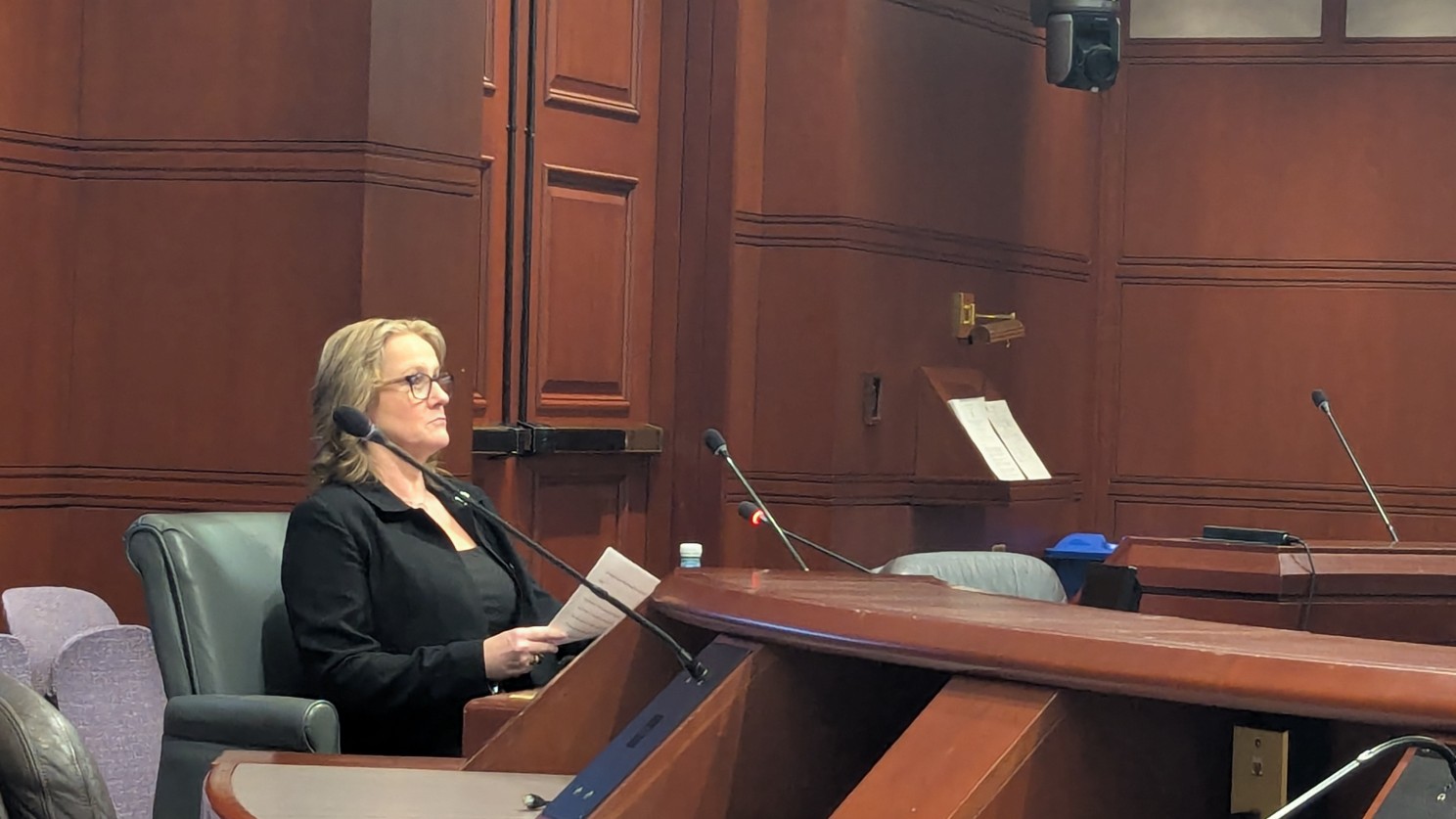
During the 2026 CT legislative session, NGACT advocated for, and ultimately secured, a fee waiver at public colleges to supplement the existing National Guard Tuition Waiver. This long-awaited legislation effectively secured free public college for members of the Connecticut National Guard. However, NGACT President Katie Zarzycka is not content to rest on her laurels. Having served in the National Guard for 31 years, Katie understands that access to employment opportunities has historically been the driving force behind National Guard recruiting efforts in Connecticut. The tuition waiver, an abbreviated police academy, and unofficial connections to employers through the Guard network have provided thousands of Soldiers and Airmen with exactly what they hoped for when they signed on the dotted line; A head start in their civilian career while serving their country and state in the armed forces. This access opportunity and stability is a far rarer commodity in the vast ranks of the United State’s full-time (Title 10) force.
But there exists a gap in this classic National Guard sales pitch. There is little direct access to one of Connecticut’s best drivers of opportunity. The Connecticut National Guard provides precious little, in terms of a foot-in-the-door, to the trades. Historically in the United States, a four-year degree was the gold standard in wealth creation. In 1984, 2 years after the implementation of the National Guard Tuition Waiver, according to a report conducted by the U.S Census Bureau, “Regardless of field, persons with a degree beyond high school had average monthly incomes that were substantially larger than that of persons with a high school diploma only ($1,910 vs. $1,045).”
However, in 2026, while people with higher levels of education continue to outperform those with less education in terms of average pay, workers in the trades also outperform their non-college counterparts. Now consider that, according to Military One Source,
57.3% of the National Guard holds a high school diploma as their highest level of education. Herein lies the issue. While access to higher education remains the National Guard’s best recruiting tool, it will not be utilized by over half of the military population. Fortunately, NGACT has a solution. The concept has been coined, Troops-to-Trades and President Zarzycka says that it will be the primary focus of NGACT’s legislative efforts in 2027. Troops-to-Trades is less a single proposal but rather a series of concepts that can be actioned at different levels of government.
First, there is the Troops-to-Trades language that passed during the 2026 legislative session and has since been signed into law by Governor Lamont. This legislation requires the Department of Labor, Department of Veteran’s Affairs, and the Connecticut Military Department to actively seek out ways to introduce current and former members to opportunities in the trades. It also requires that these agencies host public job fairs geared to members of the active-duty force and reserve components. This language found in PA 26-35 provides a framework for these agencies to drive Soldiers and Airmen to trades where they can continue to work and serve within the state. The only issue with the legislation is that it does not provide specific funding or staffing for these efforts, limiting their effectiveness.
Second, Troops-to-Trades legislation will seek to provide the necessary funding and staffing to participating agencies that will allow them to more actively seek out opportunities in the trades for members of the National Guard. Agencies would be empowered to create relationships with the building and trades unions, relevant non- profits, and other organizations that share the same goal. For example, the fiscal note for PA 36-35 originally noted a requirement for 2 additional employees for the Military Department that would oversee a state supplement to the existing federal transition assistance program which already performs some of these functions with limited resources.
Finally and likely most importantly, Troops-to-Trades would seek to provide Service Members with credit toward an apprenticeship or other training stemming from the training they received for their Military Occupational Specialty. Such accreditation is currently provided by government agencies such as the Department of Labor, the Department of Consumer Protection, and by the trades themselves through apprenticeships. For reference, while a 31B (Military Police) in the Army received credit for his or her law enforcement training during AIT, there is no such credit given for 91Bs (Wheeled Vehicle Mechanic) or Air Force 2A7X3s (Aircraft Structural Maintenance). There is currently no way for serving members to count their military training toward their time as an apprentice. Thile the specific scale of the accreditation should be left to experts, NGACT argues that there should at least be some recognition of the training received by members of the National Guard when pursuing a career in the trades.
While it is currently in Vogue to claim that a 4-year degree is next to worthless, despite all evidence to the contrary, Connecticut would be foolish not to encourage its citizens to view the trades as a legitimate career path. The National Guard would be foolish to ignore the increasingly substantiation segment of the population that feel college is not for them and wish to pursue other options. From a recruiting standpoint, The National Guard, which has long been a facilitator of future professional achievement, must remain relevant to modern trends. Furthermore, an organization built on providing opportunity to its recruits cannot hope to succeed if it ignores the preferences of over half of its population. The Connecticut National Guard, dubbed Connecticut’s Home Team by its Adjutant General, Major General Evon, also has a role to play in the development of the state’s workforce. Members of the National Guard live and work in their state. Most will stay in their state during their time in service. As such, a mutually beneficial arrangement exists for the National Guard and Connecticut. By prioritizing and facilitating Troops-to-Trades, Connecticut will benefit from a tranche of workers that will not simply take their hard-earned education and move to Florida. The people who will serve the state during its most difficult times and during its worst emergencies will be the same people who run its factories, repair its elevators, build its desperately needed new homes, work its sheet metal, and pay its taxes. The potential value of this arrangement speaks for itself. Be on the lookout for more to come on Troops-to-Trades from NGACT, Connecticut’s Home Team’s Home Team.