
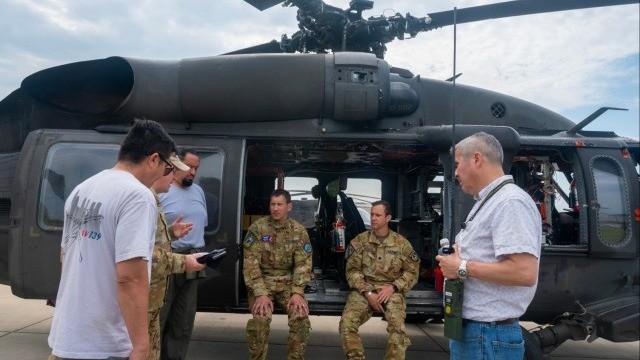
The Innovation: Autonomy Built for Survival
Recently, the U.S. Army conducted a successful test of a UH-60 Black Hawk helicopter equipped with Mission Adaptive Technology—a system designed to autonomously fly the aircraft to safety if the pilot becomes incapacitated.
At the heart of this system is a wearable solution called Operator State Monitoring (OSM), a biometric armband that tracks vital signs such as heart rate and oxygen saturation. If the system detects critical readings—such as unconsciousness or health failure—it signals the aircraft’s autonomy protocols to take over, stabilize flight, and prepare for emergency procedures.
This isn’t just automation—it’s responsive, human-centered AI designed to protect lives.
What Makes This Groundbreaking
Mission Adaptive Technology does more than navigate. It connects human status directly to aircraft behavior—linking real-time biometric data with live command-and-control systems.
Key Components:
- OSM Wearable: Tracks biometric signals in real time, functioning like an advanced EKG.
- Autonomous Flight Protocols: Take over flight operations instantly when thresholds are crossed.
- Live Data Integration: Streams real-time information to medical and operational teams on the ground.
This represents a new model for defense AI—one that supports human operators, enhances survivability, and ensures mission continuity in worst-case scenarios.
Why This Matters for the National Guard
Every day, National Guard aviators fly critical missions—combat deployments, disaster relief, medevac, search and rescue—often under challenging conditions and with aging equipment. Many of these missions are flown in the same Black Hawk airframes used in the test.
The stakes are just as high. The technology must be just as available.
Guard pilots log over 100,000 flight hours annually in both domestic and overseas operations. Their safety—and the success of their missions—demands access to the same life-saving technologies being tested on the active-duty side.
This innovation underscores a broader truth: life-saving tools like Mission Adaptive Technology must not be limited by component or status. They must be integrated across the total force, including the National Guard.
The Role of NGACT: From Awareness to Advocacy
This story isn’t just a showcase of technological progress. It’s a signal—a reminder that associations like the National Guard Association of Connecticut (NGACT) have a critical role to play in surfacing stories, identifying capability gaps, and advocating for action.
NGACT exists to do more than maintain tradition or host events. We are here to:
- Identify innovations that can save lives and improve readiness
- Engage policymakers, industry, and military leadership to push for Guard inclusion
- Support pilots, crew members, and units in securing what they need—now, not a decade from now
What Comes Next: Building the Advocacy Plan
NGACT is committed to doing the work that ensures our Guard members have access to the tools, training, and technology they need to succeed and survive. That means:
- Briefing Connecticut’s elected officials and National Guard leadership on the implications of mission adaptive technologies
- Partnering with innovators and defense tech leaders to learn what’s next and how the Guard can get involved early
- Collaborating nationally with NGAUS and other state associations to unify efforts around bringing this technology to the entire force
- Creating pilot-ready frameworks for testing and fielding in Connecticut Guard units
Why Associations Like NGACT Matter
When the Guard is underfunded, under-equipped, or overlooked—associations fill the gap. They bring people together. They elevate needs. They build coalitions. They turn headlines into outcomes.
NGACT is doing this work every day—quietly, consistently, and persistently. But we cannot do it alone.
A Call to All Members—and Future Members
To our members: Thank you for standing with us. Your support makes this mission possible.
To non-members: This is what it means to belong. To be part of a team that identifies the right problems and fights for the right solutions.
Mission Adaptive Technology is just one example—but there are many more ahead. NGACT will continue working to bring innovation home to Connecticut and to every Guardsman who needs it.
Join us. Support the mission. Help us ensure that every Guard member—air or ground, at home or abroad—has what they need to make it home.
www.ngact.org/membership
executive.director@ngact.org